Fresh Water Generators & Heat Exchangers
Efficient Desalination & Heat Exchange Systems.
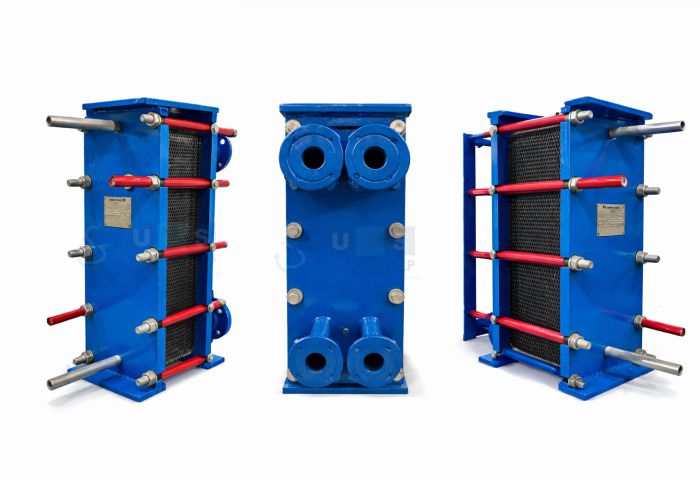
Our Advantage
- Fresh Water Generators (FWG)
- Plate Heat Exchangers (PHE)
- New & reconditioned units
- Leading marine brands
- Rigorous validation process
Looking for engine parts?
View Engine PartsAdvanced Desalination & Heat Transfer Technology
Our equipment is specifically engineered for marine applications, including air conditioning, refrigeration, chillers, and heat pump systems. We provide comprehensive support from the industry's leading brands.
Whether you need new installations or high-quality reconditioned units, our technical expertise ensures a continuous supply of potable water at sea.
Industry-Leading Brands
We provide access to comprehensive support from the industry's leading brands:
Alfa Laval / Nirex
Industry-leading JWP, DPU, and JWSP series
Sasakura
Reliable AFGU and KM series desalination plants
Atlas & Rumia
Robust units for various vessel capacities
Extensive Stock List: Models & Series
We maintain a vast inventory of complete units and plate heat exchanger (PHE) components ready for immediate dispatch:
Alfa Laval
- DPR-36-C 125, DPR-36A-125, JWP-36 (125/150/200)
- JWP-26 (C80/C100), JWSP-26, HWL series
Nirex
- JWP-36-125, JWSP 36-150, JWSP 36A-36-200
- JWP-26C 80, 120DH42 series
Sasakura
- AFGU-3, AFGU-4, AFGU-5, AFGU-6, AFGU-7
- AFGU-S-51, KM-30
Atlas
- FWG AFGU through AFGU 7
Rumia
- AW 12-5, SY250A-2
Uncompromising Quality & Certification
In the marine environment, equipment durability is non-negotiable. Every Fresh Water Generator and Heat Exchanger undergoes a rigorous validation process:
NDT & Pressure Testing
All shells, plates, and gaskets are subjected to Non-Destructive Testing (NDT) and hydrostatic pressure trials to ensure leak-free operation
Technical Data Support
We provide full technical documentation and service history for reconditioned units
Certification
Internal test certificates are standard. Upon request, we can facilitate inspections by IACS member classification societies (DNV, ABS, Lloyd's Register, BV) to ensure full vessel compliance
Technical Insights: Marine Heat Transfer & Desalination
Expert engineering observations from our dismantling facility.
What Is A Marine Fresh Water Generator
A marine Fresh Water Generator (FWG) is a low-pressure distillation plant that utilizes waste heat from the main engine jacket cooling water to evaporate seawater under a vacuum. This produces high-purity distilled water for boiler feed and domestic consumption. The system heavily relies on Plate Heat Exchangers (PHEs)—specifically the evaporator and condenser sections—which use corrugated titanium plates to transfer heat efficiently between fluids without mixing them. We stock systems primarily from Alfa Laval (Nirex) and Sasakura.
Applications
FWGs are essential for vessel autonomy, eliminating the need to purchase fresh water at port. Beyond desalination, standalone Plate Heat Exchangers are utilized extensively throughout the engine room as central coolers (cooling fresh water with seawater) and lube oil coolers. Their compact design and high thermal efficiency make them vastly superior to older shell-and-tube heat exchangers, especially given the space constraints of modern engine rooms.
Common Failure Modes
In FWGs, the most frequent issue is scale formation (calcium carbonate/sulfate) on the evaporator plates due to improper chemical dosing or excessive boiling temperatures, which drastically reduces fresh water output. In all plate heat exchangers, the NBR/EPDM elastomeric gaskets eventually harden and fail, causing external leakage or, worse, cross-contamination between fluid circuits. Furthermore, while titanium plates are highly resistant to seawater corrosion, they can suffer from stress corrosion cracking if subjected to severe vibration or improper tightening torques.
Inspection Process
When overhauling an FWG or PHE, we completely disassemble the plate pack. Every titanium plate is chemically bathed to remove scale and biological fouling, then subjected to NDT (Non-Destructive Testing) using UV dye penetrant testing to detect pinhole cracks. We discard all old gaskets. The plates are then re-gasketed using OEM-equivalent, clip-on or glued gaskets (depending on the model). Finally, the assembled heat exchanger is hydrostatically pressure-tested on both circuits to verify absolute sealing integrity.
Buyer Considerations
If you are experiencing a drop in FWG production, you may only need a replacement titanium plate pack rather than a complete unit. When requesting plates, you must specify the exact model (e.g., Alfa Laval JWP-26-C80), the total number of plates, and the gasket material required. If purchasing a complete FWG skid, verify the heating medium requirements (jacket water flow rate and temperature) match your main engine's parameters to guarantee the rated Tons Per Day (TPD) output. For further technical considerations on sourcing second-hand equipment, consult our technical guides.
FWG & Heat Exchangers — Common Questions
Answers to specific questions our clients ask about sourcing marine heat transfer equipment.
How does scaling affect the Tons Per Day (TPD) output of a marine fresh water generator?
+
Calcium carbonate and sulfate scaling on the evaporator titanium plates significantly reduces the overall heat transfer coefficient. This thermal insulation effect prevents optimal boiling of the seawater feed, causing a severe drop in the distilled water Tons Per Day (TPD) production rate.
What is the recommended testing procedure for plate heat exchanger (PHE) gaskets?
+
After re-gasketing with OEM-equivalent NBR or EPDM, the entire plate pack must be compressed to its precise tightening dimension (A-dimension). It is then subjected to a hydrostatic pressure test on both the primary and secondary fluid circuits to verify the integrity of the elastomeric seals and ensure zero cross-contamination.
Can individual titanium plates be replaced in an Alfa Laval Nirex evaporator?
+
Yes. If specific plates suffer from stress corrosion cracking or irreparable mechanical deformation, individual titanium plates can be swapped. However, they must match the exact corrugation pattern and thickness of the existing plate pack to maintain correct fluid distribution and prevent channel blockages.
What causes vacuum loss in a fresh water generator system?
+
Vacuum loss is typically caused by a failing ejector pump, degraded mechanical seals on the brine/distillate pumps, or air leaks at the evaporator shell gaskets. A loss of vacuum raises the boiling point of the seawater feed, completely halting the evaporation process driven by main engine jacket cooling water.
Request a Quote
Contact us with your Fresh Water Generator and Heat Exchanger requirements today. Our team will provide you with detailed information, pricing, and availability for high-efficiency marine desalination solutions from the industry's leading brands.