Introduction
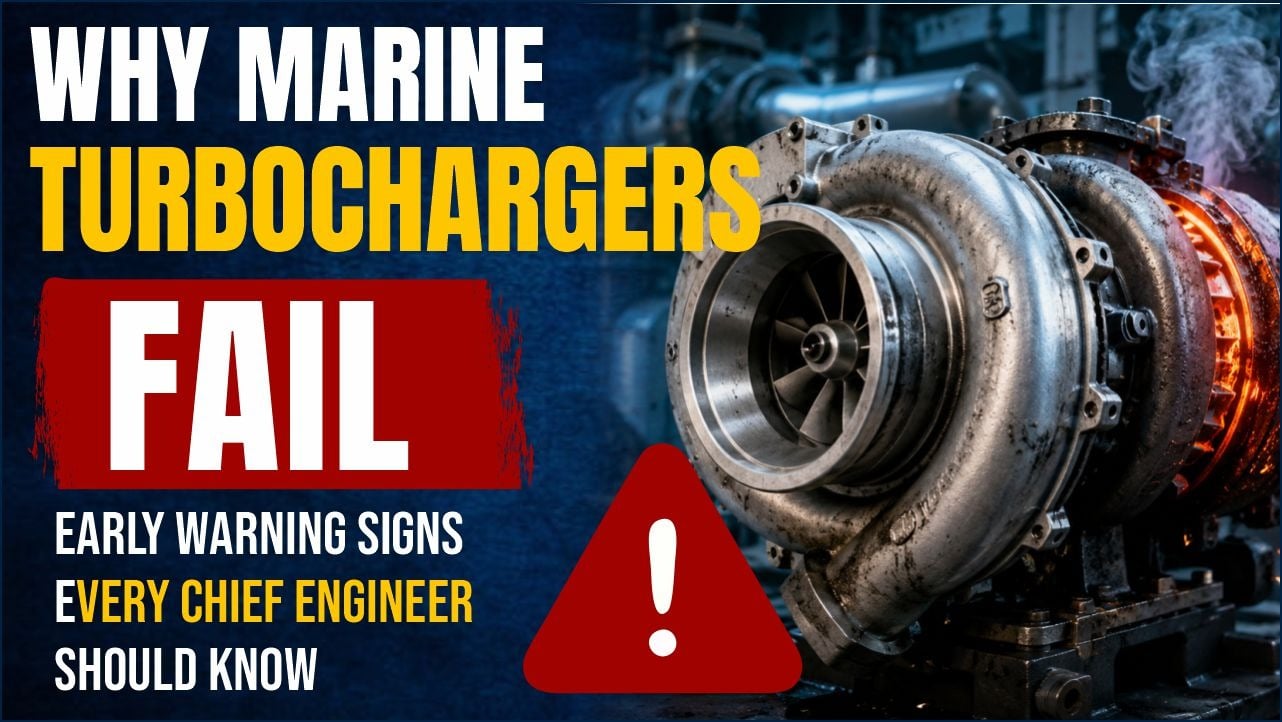
A marine turbocharger spins at incredible speeds—often exceeding 20,000 RPM—while operating in an environment of extreme heat and corrosive exhaust gases. When a turbocharger fails, the main engine loses scavenge air pressure, resulting in severe power loss, black smoke, and potential damage to the engine itself. Turbocharger failures are expensive, but they rarely happen without warning.
Most Common Turbocharger Failures
- Bearing damage: The rotor shaft floats on a film of lubricating oil. If the oil is contaminated or the supply is interrupted even briefly, the bearings wipe, causing catastrophic rotor-to-casing contact.
- Rotor imbalance: Uneven carbon buildup on the turbine blades or damaged compressor fins throws the high-speed rotor out of balance, destroying the bearings.
- Blade erosion: Abrasive particles in the exhaust gas (like unburned fuel or cat-fines) slowly erode the turbine blades, reducing efficiency.
- Foreign Object Damage (FOD): A broken engine valve or a loose bolt sucked into the compressor wheel will instantly shred the blades.
Warning Signs Before Failure
Warning Sign Possible Cause Increased Vibration Rotor imbalance (carbon buildup or chipped blade) Surging (Barking noise) Fouled compressor wheel, blocked air filter, or hull fouling increasing engine load Oil Leakage at Blower Side Worn labyrinth seals or blocked sealing air passages Reduced Boost Pressure Eroded nozzle ring, damaged turbine blades, or exhaust gas leaksInspection Procedure
Routine inspections prevent catastrophic blowouts:
- Visual inspection: Remove the air filter and inspect the compressor wheel for nicks, cracks, and oil weeping.
- Rotor checks: Manually spin the rotor. It should spin freely without binding and take time to coast to a stop. Check for axial and radial play.
- Clearance measurements: Use feeler gauges to measure the critical clearance between the turbine blades and the casing (K-value) during scheduled overhauls.
Preventive Maintenance Checklist
- Monitor and log lube oil pressure and temperature daily.
- Purify system lube oil continuously to remove particulates.
- Perform regular water washing of the turbine and compressor sides as per the maker's schedule.
- Clean the air filter silencer regularly.
- Renew bearings strictly according to running hour limits (e.g., 12,000 hrs), even if they look fine.
Frequently Asked Questions
Can a damaged turbocharger rotor be repaired?Sometimes. Bent compressor blades can occasionally be straightened by specialists, and the rotor must always be dynamically balanced afterward. However, severe damage usually requires replacing the complete rotor assembly.
Why is turbocharger run-down time important?Run-down time is the time it takes for the rotor to stop spinning after the engine is shut down. A suddenly decreasing run-down time strongly indicates bearing wear or internal rubbing.