For ship owners, technical superintendents, procurement managers, and marine repair companies, purchasing used marine spare parts can significantly reduce maintenance costs without compromising operational reliability. However, not every used spare part available in the market offers the same level of quality.
Alang Ship Breaking Yard in Gujarat, India has become one of the world's largest sources of genuine marine machinery and engine spare parts recovered from operational vessels. While sourcing from Alang offers substantial cost advantages, buyers must follow a systematic inspection process before making any purchase decision.
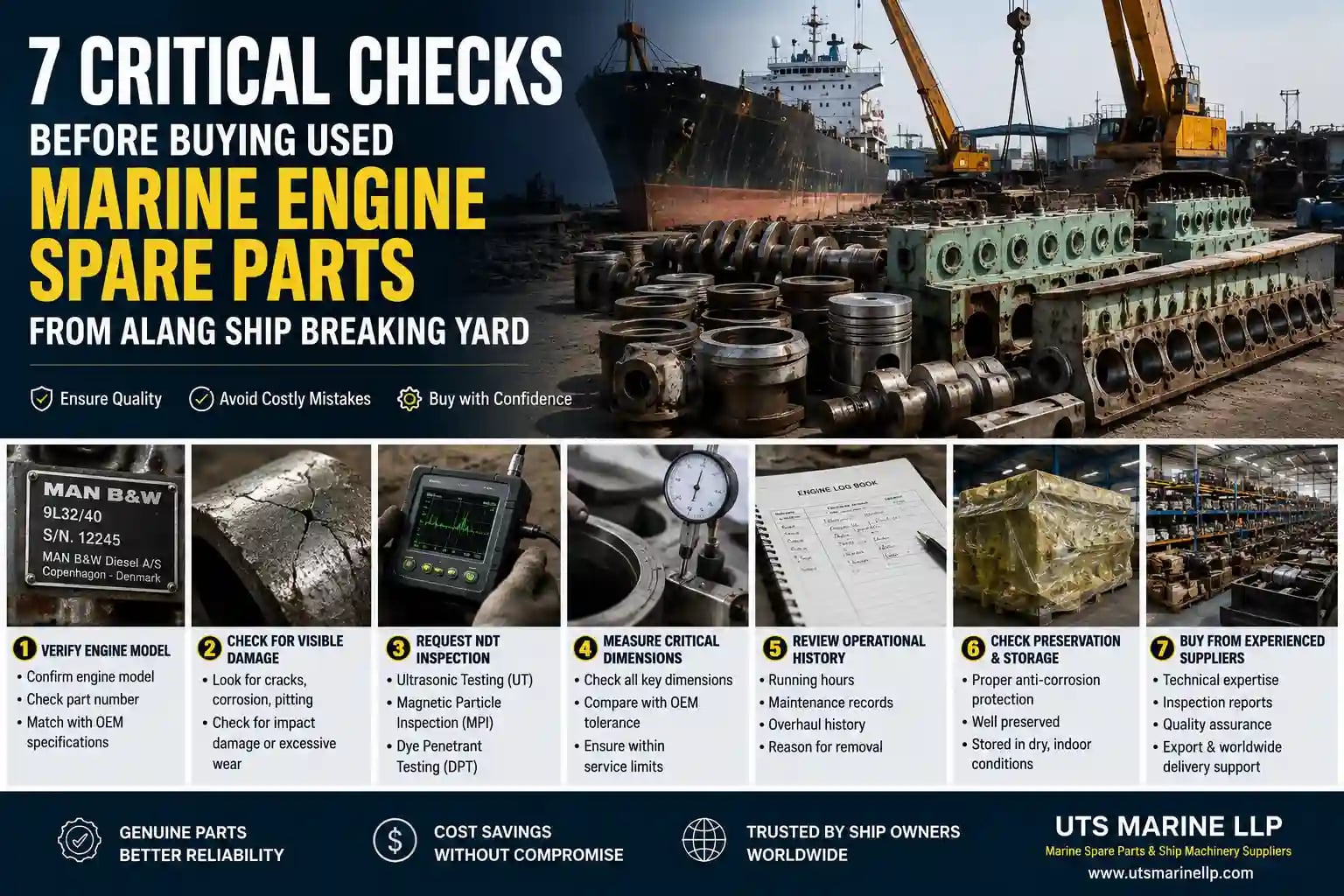
1. Verify the Original Engine Model
The first step is confirming that the spare part originates from the exact engine model required.
Many marine engine series have visually similar components that differ in dimensions, material specifications, or operating tolerances. Always verify:
* Engine model number
* Part number
* Serial number
* Manufacturer markings
A mismatch can result in installation delays and costly operational problems.
2. Check for Visible Structural Damage
Before procurement, conduct a detailed visual inspection.
Look for:
* Cracks
* Corrosion
* Deep pitting
* Impact damage
* Excessive wear marks
Parts exposed to seawater ingress or long-term neglect may appear usable but could fail prematurely under operational loads.
3. Request NDT Inspection Reports
For critical engine components, Non-Destructive Testing (NDT) is highly recommended.
Common inspection methods include:
* Ultrasonic Testing (UT)
* Magnetic Particle Inspection (MPI)
* Dye Penetrant Testing (DPT)
NDT helps identify hidden defects that cannot be detected during visual examination.
4. Measure Critical Dimensions
Used marine spare parts should always be measured against OEM tolerances.
Particular attention should be given to:
* Cylinder liners
* Pistons
* Cylinder heads
* Crankshafts
* Connecting rods
Dimensional verification helps determine whether the component remains within acceptable service limits.
5. Review Operational History
Whenever available, obtain information regarding the vessel and engine from which the component was removed.
Important factors include:
* Running hours
* Maintenance records
* Previous overhaul history
* Cause of vessel dismantling
Understanding the operational history provides valuable insight into the remaining service life of the component.
6. Ensure Proper Preservation and Storage
Even high-quality spare parts can deteriorate if stored incorrectly.
Check whether:
* Machined surfaces are protected
* Anti-corrosion grease has been applied
* Components are covered and stored indoors
* Moisture exposure is controlled
Proper preservation significantly improves long-term reliability.
7. Buy from Experienced Marine Suppliers
The supplier's technical knowledge is often as important as the spare part itself.
An experienced marine supplier should be able to provide:
* Technical verification
* Inspection reports
* Photographs
* Measurement records
* Packing and export support
Working with a knowledgeable supplier reduces procurement risks and improves confidence in the purchased equipment.
Why Marine Buyers Source from Alang
Marine operators across the world continue to source spare parts from Alang because it offers access to genuine OEM components from major engine manufacturers including MAN B&W, Wärtsilä, MAK, Sulzer, Daihatsu, Yanmar, Bergen, Caterpillar, and Niigata.
When properly inspected and verified, used marine spare parts can provide substantial cost savings while maintaining operational reliability.
Conclusion
Purchasing used marine engine spare parts should never be based on price alone. Technical verification, inspection procedures, dimensional checks, preservation standards, and supplier expertise all play critical roles in ensuring successful procurement.
Following these seven checks helps ship owners and marine procurement teams reduce risk, improve reliability, and maximize value when sourcing marine spare parts from Alang Ship Breaking Yard.
UTS Marine LLP supplies inspected marine spare parts, ship machinery, marine engines, and industrial equipment to clients worldwide. Contact our technical team for sourcing assistance and availability information.
The 7-Point Technical Inspection Checklist
| Check Point |
Method |
Rejection Criteria |
| Crankshaft Journals |
Micrometer & MPI |
Ovality > OEM limits; subsurface cracks detected. |
| Cylinder Covers |
Hydrostatic Testing |
Pressure drop over 30 mins; visible jacket water leaks. |
| Connecting Rods |
Laser Alignment |
Distortion or "twist" in the rod body; fretting at serrations. |
Frequently Asked Questions
How do I know if a salvaged part is genuine OEM?
Always request the original engine manual page and verify the stamped part numbers against the casting marks. Reputable suppliers at Alang ship recycling yards will provide traceability to the original vessel.
Do salvaged parts come with a warranty?
Yes, premium suppliers provide a functional warranty, guaranteeing the part will pass independent IACS classification society testing upon installation.